Words for Permafrost
conversation between artist Hanna Zubkova and scientist Valentina Palamarchuk around their collaboration within the artist's project Solid Amid
Salekhard National Library, 2024 -2025
Efim Khorolya (Moderator)
Today’s participants are Valentina Palamarchuk, a cryologist and researcher at the Arctic Research Center, and Hanna Zubkova, an interdisciplinary artist working with installation and research. The format is simple: we will begin with a conversation between the speakers, followed by questions from the audience. All questions are welcome.
Valentina Palamarchuk
Good evening. My name is Valentina Palamarchuk. I work at the Arctic Research Center in Salekhard and am currently a PhD student at the Institute of Geocryology in Moscow. My field of research is groundwater in the cryolithozone.
I was trained as a permafrost specialist in Tyumen, and during the final years of my undergraduate studies I realized that I wanted to focus specifically on water. Water is movement, water is life, and it was important for me to study how it exists under such harsh, frozen conditions as those of the North.
Hanna Zubkova
My name is Hanna. I am an artist working in the field of contemporary art. For me, art is a dialogue between ideas and forms, rather than an autonomous work with form itself. I'll start with a brief presentation of my background and some of my projects,
In 2011, I graduated from MGIMO, and later went on to study philosophy at the Sorbonne. There, at the intersection of philosophy and art, I worked with the concept of conceptual metaphor. A conceptual metaphor is a tool that helps us orient ourselves within space and systems. For example, a computer interface offers us a “desktop,” folders, windows — and we immediately understand how to navigate them, even though in reality they consist only of zeros and ones.
On the one hand, conceptual metaphors simplify life, making the world more accessible. But they also conceal complexity, disabling certain aspects of reality. I became interested in precisely these gaps — the places where the complexity of the world begins to surface. Art became, for me, a way of knowing the world from the perspective of its complexity.
After that, I graduated from the École des Beaux-Arts in Paris. I am originally from Minsk and live between Moscow, Minsk, and Paris, but because of my interest in field research I often find myself in very different places.
Today, I would like to begin by speaking briefly about the projects that led me to this meeting with Valentina, and then pass the worf to her, so that she can speak about what brought her here and what followed.

1

2
One of my earliest projects that became significant for me in this context was made in 2014 and reflected, among other things, on the properties of language — on how it can both reveal and confuse at the same time.
The project was titled Axis of Revolution. Together with a colleague, we crossed Moscow on foot from north to south, carrying a rectangular steel beam on our shoulders. We began at dawn and finished at sunset. The trajectory of our movement formed a cross with the trajectory of the sun. At the moment of the sun’s zenith, we passed through Revolution Square.
What mattered to me in this project was the collision between experience and language. The phrase “axis of revolution” attracts many meanings associated with revolutionary movements, political upheavals and historical events. Yet in fact the term belongs to Copernicus, who used it when speaking about the rotation of celestial bodies. The axis of revolution is, quite literally, an axis of rotation.
So what is a revolution — an overthrow, or a return?
I was also interested in how the attempts to describe experience through various models produces repetition. If we look, for example, at a map of Moscow, it appears as a core surrounded by rings that grow denser toward the center. We depict the solar system in much the same way. What it actually looks like, we may never know with certainty. But the model repeats itself again and again.
This gesture — strange at first glance and not always obvious to the viewer, who sees only fragments of what is happening — ultimately formed a portrait of the city. The performance lasted 17 hours; we walked approximately 45 kilometers. Through this movement, through this axis that seemed to pierce Moscow from end to end, the city gradually unfolded. We began in residential outskirts with their typical architecture, passed through the Garden Ring and other rings, and at the center crossed Revolution Square and the Kremlin — symbolic points associated with power. We ended the journey in darkness, on the outskirts of Moscow, at the south point of the MKAD.
3

4

5
The next project, begun later, in 2021, was titled False Sun. If Axis of Revolution brought me closer thematically to questions of language — including scientific language and the models of the world it proposes — False Sun brought me closer to this theme territorially. The project is closely connected to the North, specifically to Vorkuta and, more precisely, to the settlement of Rudnik. Rudnik is a ghost settlement, one of the first founded for coal extraction.
The project began with a rather strange discovery: I came across the personal archive of a Soviet philosopher who worked on epistemological questions of truth. Epistemology is the branch of philosophy that asks what we know, how we know it, and how this knowledge relates to reality.
What interested me was that this philosopher, although living and working in Moscow in the 1970s, nevertheless encompassed the entire territory of the Soviet Union within his activity. And within this imagined space, the North emerged as an extreme point — as if the edge of the empire, the edge of the map, a territory beyond familiar time, beyond the Arctic Circle.
I traveled there with a strange task: to try to capture a sunset — to find the most beautiful, the most “final” sunset, as if it were the end of the world. Very quickly, however, it became clear that this task was impossible. At the time I was there, the sunset was constantly postponed. It was always happening the day after tomorrow. The end of the day never arrived. This is, of course, easy to explain — the polar day, and the specific conditions of a territory that lies outside our habitual, central, “normal” understanding of time, where we know that the sun sets at ten in the evening.
I tried to capture it in different ways. I did this at the very edge of the settlement of Rudnik, on the ruins of the last residential building; on Peace Square in Vorkuta; and on the border between Europe and Asia, near the Ural Mountains. I even descended into a coal mine, trying to capture the sunset underground.
Nothing worked.

8


6
7

At a certain point, I realized that I could not fix this ending, that I could not witness this sunset. And so I decided to leave a transparent fabric on the ruins — in the hope that one day it might absorb the fading of light at the edge of a former empire. The ruin turned out to be a former kindergarten at the very outskirts of Rudnik. The kindergarten had been built but never used: coal extraction began before normal living conditions for people had been established. I left the transparent fabric there as a kind of anticipation of an event that continually slips away.
From one of the destroyed walls of this building — where the wall no longer existed and the view opened outward — I took a fragment of masonry. This wall could be called a “fallen sky”: it essentially marked the horizon, the sky, the line of sight.
From this fragment, I later created an installation that was exhibited in Saint Petersburg at the Russian Ethnographic Museum. The sculpture was installed in the hall dedicated to settlement the Russian ethnicity group and consisted of reflective surfaces onto which a mosaic of these fragments was laid. Among other things, the museum exhibition itself was reflected in them.
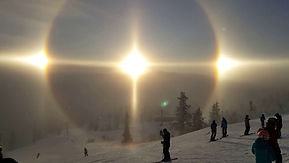
The title False Sun refers to a meteorological and optical phenomenon that occurs only under specific conditions and only for an observer located at a particular point. It is a phenomenon in which light reflections — doubles of the sun — appear next to it.
This phenomenon points to a paradox of testimony: it can only be seen by one person or a group of people in a specific position. If you are outside that position, you will not see it. And when we try to tell someone about this experience, we inevitably enter the realm of mythology — a space of narration that can only be trusted.
We can say, “I saw three suns in the sky,” and from there everything rests on trust between the storyteller, the story and the listener.
This project unfolded into the installation False Sun. The Catcher, which brought together video, research materials, and the artist’s failed attempts to capture the sunset. It was within this project that I first encountered permafrost — before meeting Valentina, but already as both a concept and a reality.
This encounter emerged through a question: how, on what appears to be solid ground, on what is perceived as a stable foundation, does a human attempt to build an eternal city?
Rudnik, like Vorkuta as a whole, was originally designed as a city “for centuries.” It was imagined as an eternal city in the North, a kind of "pearl" of the region. But by the time I arrived, it already resembled an ancient ruin.
This raised a question for me: how do we attempt to live eternally on permafrost? This is an obvious oxymoron. And language itself begins to function differently here — it no longer simply describes reality, but becomes poetic.
As it turned out, permafrost is not eternal at all. Valentina and other scientists later helped me understand this. And just as permafrost is not eternal, neither are our plans to build great cities designed for an infinite future.


9
10
11
12


13
14

In this juxtaposition of human infrastructure and permafrost as a medium with which we attempt to coexist, I found myself in Salekhard.
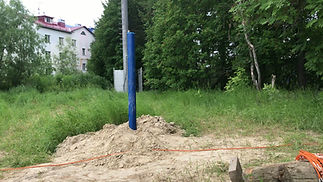
One of the objects of my research there was a field near Patrikeeva Street — a former experimental field where experiments were once conducted to determine whether it was possible to coexist with permafrost as a climatic condition. In particular, whether anything could be grown there to sustain life and nourishment.
Today, the field is abandoned as an agricultural site, but it has become the site of other tests.
When I arrived, a hydrogeological borehole was being drilled in the field. This was completely unexpected for me. Until that moment, drilling and permafrost had appeared very differently in my imagination.
In the video you see, the climax of the drilling is captured — the moment when water from underground layers bursts to the surface under pressure. For me, this moment became almost a physical proof that permafrost is not a monolithic solid, but a medium that exists in multiple states simultaneously.
When the borehole was prepared for further observation, I came to the Arctic Research Center and quite literally asked: what is this, and why is it needed? It was at that moment that Valentina entered my life.
And here I pass the word to her — so that she can speak about what she was working on before our meeting, and what led her to this point.


15
16
Valentina Palamarchuk
In fact, just before meeting Hanna, I had returned from a field expedition. Hanna has already mentioned that working “in the field” is close to her, and this was probably our first point of contact as an artist and a scientist.
I had just come back from Chara. In the photograph you see, I am standing in a sandy massif — one of the objects of my research in Transbaikalia.
Fieldwork is always physically demanding. You constantly walk with a large backpack, carry equipment and samples, move long distances on foot. You have to stay very attentive so as not to get lost, not to end up in a swamp or bog.
At the same time, the field is always deeply energizing. I return from expeditions emotionally charged and inspired, because in the field you are constantly encountering something new and unexpected.
When I returned, I sat down to write a scientific article. For me, this is also a creative process. I have already told Hanna that science cannot function without creativity. When you write a scientific text, you reconstruct the route, the images, the connections between observations all over again in your mind.
At the same time, together with my colleague Anna in Salekhard, we conduct hydrogeological monitoring. We also began working on the very field where the hydrogeological borehole was drilled — the place where Hanna and I met.
Hanna Zubkova
I remember that our meeting with Valentina took place in relatively calm, urban conditions — but still, on that very field. We met for literally fifteen minutes, because a technical operation had to be carried out.
The task was to put a special camera into the borehole, which was supposed to show something. And this was one of those moments when neither the artist nor, I think, the scientist can be entirely sure where the field will lead.
You may have a preliminary idea, an expectation of the result, but very often you find yourself somewhere completely different — not where you initially thought you would be.
We started watching the image transmitted by the camera. And at a certain point, off-screen, Valentina’s voice could be heard saying: “Now we are approaching the water mirror.”
For me, this expression — “the water mirror” — immediately sounded like an image. It evoked a sense of a reverse side, like in Alice Through the Looking Glass, where there is a mirror behind which another space opens.
This image — the water mirror — later became important to me and became part of the sculpture. Because several levels coincided at once: a literal scientific term, a technical process, and a poetic perception.
Beyond this direct, visual penetration into the borehole, there are other ways of working with groundwater and underground layers — with what is generally invisible. These approaches took shape for me through conversations with Alexander Shein, another scientist from the Arctic Research Center.
These methods also became part of the installation. I was struck by how expressive the very ways in which scientists enter into contact with permafrost can be — both conceptually and formally.
This concerns the aesthetics of scientific work itself: how invisible phenomena are recorded, how models are constructed, how data are visualized. In this, I saw a strong affinity between scientific and artistic modes of thinking.
This relates to a feeling I have long had: that humans are constantly trying to penetrate inward — to reach some kind of depth. Not even the depth of the Earth as such, but a deeper solidity in general, something one might pass through.
We are not the first to lower a kind of prosthetic “eye” in order to try to see what lies inside. Valentina told me about Shargin’s well — the Shargin shaft — and that, of course, was an extraordinary story.

17


18
19


20
21
Valentina Palamarchuk
Yes, it is an extremely important object for permafrost science as a whole. It is a shaft located in Yakutsk, right in the city center. And it was the very first place where I saw permafrost with my own eyes.
Before that, I had studied what permafrost was for five years — and only after five years did I finally encounter it directly. The shaft began to be drilled back in the nineteenth century, in 1828. A representative of the Russian-American Company, Fyodor Shargin, wanted to have a well.
But when they began digging, they discovered that the permafrost was getting thicker and thicker, and they never reached water — it was solid ground. They managed to drill more than one hundred meters. After that, scientists from all over the world began to come and ask: what is this phenomenon?
It was precisely from this object that the development of geocryology as a scientific discipline began. For me, seeing it for the first time was a powerful stimulus — a feeling that I was probably moving in the right direction. It is a very beautiful object, and to see it in person is truly a strong experience.
Hanna Zubkova
Am I right in understanding that it was there, near Yakutsk, that one of the first objects of your research is located — the one that personally struck me in the most pleasant way? In the sense that I, for example, had no idea such things even existed. I mean sandy massifs in the permafrost zone. Could you tell us about them?
Valentina Palamarchuk
Yes, sandy massifs are something I absolutely love. When I was at a conference in Yakutsk, we had a field school at the Makhatta tukulans, slightly north of the city. “Tukulan” is a Yakut term meaning desert — deserts within the permafrost zone.
I was very lucky, because already in my first year I decided to study these formations, and just a year later I found myself there in the field. What interested me was that these massifs contain remarkably beautiful springs with clean drinking water. There is a great deal of water there, and it can be used for domestic water supply. Eventually, this became the object of my scientific research.
If you look at a satellite image of the tukulan, it appears as an anomalous zone: taiga and permafrost all around, and a desert in the middle. And within this desert, there is no permafrost — its own specific climatic conditions form there. Winters are colder, summers are hotter, and more precipitation falls there.
When I first saw the spring funnels, or spring cirqus as they are also called, it was absolutely mesmerizing. Seeing it in person is incredibly beautiful — water literally bursts out of the ground. In some places, you can see direct breakthroughs of water, and the impression is very powerful. We walked many kilometers across these springs, mainly collecting samples for chemical analysis and measuring water discharge.
Hanna Zubkova
Could you explain a little how this is even possible? In the usual understanding, a desert — like the Sahara, for example — does not seem like a place where such funnels could appear. Are these a kind of oasis, or something else?

22


23

24


25


Valentina Palamarchuk
In principle, the comparison is possible. An oasis is also a wet place with a large amount of water. And spring cirques can, to some extent, be compared to oases.
This is water that gathers from all sides, including through infiltration. In the case of the Makhatta tukulan, it is most likely infiltration water — essentially rainwater. Precipitation filters through the sand, and the area from which infiltration occurs is very large — more than two hundred square kilometers. This volume of water is sufficient to feed the springs.
In winter, when there is less precipitation, the springs accordingly produce less water.
Hanna Zubkova
These really are enormous spaces. As I understand it, they literally look like a desert and consist of sand similar to that of the Sahara?
Valentina Palamarchuk
Yes, this is the result of wind activity. These sands are called aeolian — they are very well sorted. In deserts, a specific relief forms: dunes, ridges. At the Makhatta tukulan, they are not as strongly expressed; rather, they are small dunes.
In the photograph, you see a deflation basin — a very beautiful place. It forms as follows: light sand is blown away by the wind, while heavier minerals remain on the surface and create a very clear, almost graphic pattern. The boundary between them is clearly visible.
Hanna Zubkova
I was very struck when you first told me about aeolian theory. Aeolus, after all, is the god of the wind in ancient Greek mythology, and the term itself sounds almost poetic. And then you said, “Well yes, it’s the work of the wind.” And I thought — what do you mean, the work of the wind?
And you replied: “Yes, everything works — rivers work, water works.” And then I realized that this is purely geological terminology — the geological work of wind, the geological work of water. Nothing is asleep; everything is at work.
Valentina Palamarchuk
Yes, and there is another very interesting aspect here. These black minerals are magnetite inclusions. We literally passed a magnet over the surface of the sand for about fifteen seconds — and in the end, such a beautiful object formed. Almost like a work of art.
Hanna Zubkova
So you mean that in this sand — which stays on your fingers and which appears to us as a simple pale-yellow field — there are actually particles that can be collected by a magnet?
Valentina Palamarchuk
Yes, sand is not homogeneous at all. It contains various inclusions of different minerals. To be honest, I no longer remember all their names, but there are specialists who work precisely with this — they examine individual grains under a microscope, study their surface, and can say through which processes a grain has passed, where it has “been.” This, of course, is also astonishing.
Hanna Zubkova
Am I right in understanding that this is not the direct object of your primary research? Since you work in hydrogeology, with groundwater in cryolithozone conditions. And yet, as a researcher — and simply as a person in the field — you still pay attention to things that do not directly belong to your topic, but nevertheless attract your interest.
It seemed to me that a researcher is never confined strictly within a single discipline. One is constantly positioned somewhere nearby, in adjacent, interdisciplinary zones, noticing what does not formally belong to one’s task.
Valentina Palamarchuk
Yes, in fact we notice many things everywhere. When you walk through the field, for example, you see lichens. I do not study lichens, but they still draw attention, because they stand out from the background.
At the tukulans alone, there are around 160 species of lichens, and there are people who study precisely them.
There are also other interesting organisms. For example, fungi — quite strange in appearance. A desert might seem like an uninhabited place, with extreme microclimatic conditions where survival appears almost impossible. And yet, some organisms still find their place there.
The flora is truly unique. These are harsh conditions for plants, and yet endemic species grow there. For example, this fungus — at first I had no idea what it was. We saw it, decided to pull it out and examine it, and it turned out to have a root… I don’t even know how to compare it — something like a mollusk, slightly unpleasant to the touch.
I still don’t know what this fungus is called. I have shown it to different people, but they couldn’t identify it either. Perhaps one day I will find out.
Hanna Zubkova
When you were telling me about your field sites, you drew my attention to one of your photographs. And I asked myself: what are we actually seeing here?
What was most striking is that I showed this photograph both to artists and to friends from other fields, and nobody said, “I see an aeolian form,” or “I see a trace.” People said, “It’s probably a worm,” or “It’s probably an ant.”
But we don’t see a worm or an ant here. We see a trace.
And I was struck by how similarly we operate in art: through referential relations, through relating what we see to an event that took place here. In essence, science—as I understand it now—also works with traces, with consequences.
By observing these consequences and studying them, scientists try to reconstruct what happened. And it seems to me that we are thinking in very similar ways: from the trace we try to reconstruct an event, a phenomenon, some kind of evidence. Almost the way an archive works by itself—as an imprint of a drama that unfolded here.


26

Valentina Palamarchuk
But of course science is not limited to observation alone. We have other ways of working with data. Generally, three major groups of methods can be distinguished: field methods, laboratory methods, and desk-based work.
For me, the most interesting are field methods—because in the field we can see, touch, and feel everything directly.
My main work consists in walking from spring to spring and collecting water for different types of analysis—chemical, isotopic, trace elements. We also measure discharge. In this photograph, for instance, I am measuring discharge for the first time.
Hanna Zubkova
And what does it mean, “to measure discharge”?
Valentina Palamarchuk
It means measuring the volume of water that passes through a certain cross-section per unit of time.
For example, at this point the discharge is roughly 600–700 liters per second. This allows us to indirectly assess the water resources present here.
This is important in applied terms as well: to understand how much water we can use without harming the spring. If too much water is withdrawn, the spring may simply disappear.
For me this is also important in the context of my current research. I am now working on mapping and interpreting sandy massifs. They are becoming heavily overgrown, the area of open sand is decreasing, and this directly affects water resources.
For example, at the Makhatta tukulan, over the last 70 years the sand area has decreased by roughly 10 square kilometers. Accordingly, the water resources there have diminished. One of my articles is dedicated precisely to this site.
Hanna Zubkova
This is your scientific paper? Am I right in understanding that the data itself—and the field process of collecting it—still looks quite “magical” to an outside observer like me? I mean: some stick, some ropes… and then it somehow turns into these colored models. How does that work?
Valentina Palamarchuk
More or less like that. Most often we process data—for example, discharge: it is simply numbers. The laboratory also produces numbers, and then we operate with them.
We use statistical methods and specialized software. Here, for example, you see one result of factor analysis. Scientists relate to such methods differently, but it is still one of the tools.
And often my task is to “fit” all this data into my head somehow: to draw it, imagine it, formulate a hypothesis and then, based on these measurements, show that the hypothesis is valid.
Hanna Zubkova
I remember you mentioned that when you work with data, it feels as if there are several layers of reality. First there is this flowing, living, changing world—literally in the moment when you lower an instrument, for example. And then it turns into numbers: you return home from the field, and in front of you there is just a sequence of figures. But from them you have to arrive at a hypothesis.
So on the one hand, you must read this mathematically; on the other, you said that in your imagination all the springs, all the systems are somehow drawn—assembled into images.
Valentina Palamarchuk
Yes, that is true. These numbers form a certain picture in my head. And because I have already been on site, it is easier for me: it becomes a kind of numerical “image” in my mind.
Hanna Zubkova
And what other ways do you work in the field? What actually happens there?
Valentina Palamarchuk
We select objects that we see. For example, here—an icing (naléd’): it is dusted with sand on top. We approach such objects, обязательно take a photograph for scale, collect samples layer by layer, put them into bags, label them, and then bring them to the laboratory.
Hanna Zubkova
And what is naléd’? Is it like a “mound” of ice inside, or…?
Valentina Palamarchuk
Naléd’ can form outside the permafrost zone as well—here in Salekhard it also occurs—but in general it is more typical for mountainous regions and for Eastern Siberia.
It forms through layer-by-layer freezing: water, for example, emerges from a spring—freezes; then emerges again—freezes again. That is why naléd’ has a layered structure.
Hanna Zubkova
And why is it important to excavate and collect these bodies of ice?
Valentina Palamarchuk
Naléd’ is often formed, among other things, from groundwater—and that is exactly what I study and what interests me. Naléd’ reflects the composition of groundwater, but specifically during the winter period.
Hanna Zubkova
So, in my language, it is like a sculpture made by nature itself. You take fragments from it, pack them, and then analyze them in the laboratory?
Valentina Palamarchuk
Yes, exactly.
And there is also the question of continuity. I began studying sandy massifs thanks to my first academic supervisor, Alexander Valeryevich Boytsov. He told me about them. He worked at Makhatta in the 1970s, and this borehole is essentially the result of that work.
It is a thermometric borehole. In Salekhard there are many of them, but today they look different—usually plastic. Here, however, it is a large iron borehole. And we even found a “braid” inside: a thermometric cable-string, which can be used to record ground temperature. We pulled it out—and it turns out it is about 50 years old.
Hanna Zubkova
So scientists use not only the data they obtain here and now, but also return to data that has been collected for decades?
Could one say that contemporary approaches have changed significantly? Or have some methods remained the same? And how do you interpret data collected 50–70 years ago today?
Valentina Palamarchuk
Some methods always remain. For example, drilling: it existed before, it exists now, and it is one of the most precise methods. We drill, extract sediments, describe them—in other words, we work directly with the ground.
The “braids” have become much more advanced. And in general, the emergence of remote sensing methods and specialized software has made the work much easier. In that sense, it is of course easier for a contemporary scientist than it was before.
Hanna Zubkova
If we return to “indirect indicators” and to traces… This—what looks to both of us like an old oil painting with craquelure, as if layers are flaking off—what is it actually?
Valentina Palamarchuk
These are remnants of an icing. In the previous slides there was an icing, and when it melts, during cryogenic metamorphization certain ions precipitate. They form crusts like these.
Sometimes, when the icing has completely melted, these crusts remain on the surface. If it interests us, we can collect them too and send them to the laboratory to determine their composition—even after the icing itself has existed in the past.
Hanna Zubkova
So by external signs one can reconstruct some picture of the past—but it still might not be fully reliable. We remain in the sphere, условно говоря, of speculation: there are still gaps.
For example, such gaps concern finds that you encounter simply walking across the field. What kinds of finds did you have?
Valentina Palamarchuk
To be honest, I still don’t know exactly what it was. This was one of the last routes at Makhatta. We came across this object—it is unclear how old it is: it could be from the 1970s–80s, or it could already be from the 2000s. It resembles some kind of drilling installation, but I’m not sure.
It is a “ghost of the past”: you can see that people were here before us, doing something, and probably studying as well.
And here is a different type: a hydrogeological borehole at the second research site, in Chara. The first photo, where I am standing on a dune, was taken there.
This borehole was drilled in the 1980s. According to local accounts, during drilling they may have hit a tectonic fracture, and water circulates there constantly—so the borehole functions year-round: you come up to it and there is literally a fountain around it.
In the 1970s it was studied for several years; then they decided the research was completed and simply plugged the borehole with a horizontal piece of wood. But it continues to work anyway—it is impossible to “close” it.
Hanna Zubkova
Maybe then you could tell us a little about Chara, which you just mentioned?
Valentina Palamarchuk
Chara is my love. For three years now I have been going there every year. It is a unique place, located in the Chara Basin in Transbaikalia. The nature there is incredibly beautiful—everything is very alive and dynamic.
It is a basin surrounded by mountain ranges, the Kodar.
There are many mineral resources there, interesting tectonics, many fractures along which water circulates.
In the center there is a tract called “Sands,” which is where I go. It is also a sandy massif with beautiful springs. I walk from spring to spring, collect samples, and each time I am amazed by their beauty and dynamism—because every year something new happens there, something changes. You can physically feel that everything is living.
Hanna Zubkova
And these sands—does that mean life exists there only in points, like “oases”? In the photo on the left you can see what looks like tree trunks. Do you have any hypotheses about where they come from?
Valentina Palamarchuk
Still, something does grow there: pines, larches, but they are constantly in a suppressed state. And on the slopes there are these dry trees—they look frightening.
Hanna Zubkova
Am I right in understanding that the sands there also move? That is, it’s not that a desert formed once and simply “stands” there. It changes both internally and along its borders?
Valentina Palamarchuk
Yes, it is quite mobile. I looked at old reports—there they studied how much the sand shifts over time. On satellite images you can see that the spring funnels expand: sand is carried away by water, and the funnels become wider.
Hanna Zubkova
I remember you spoke about theories of how these deserts originated. I understand it is not exactly your topic and that there are debates around it, but could you give a brief sense: where did they come from?


27




28

29



30




31
Hanna Zubkova
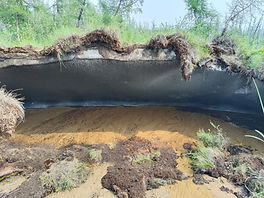
And the mound in the photo—there is water inside. Is it the water that “exploded” it, or water that flowed in afterward? And isn’t it scary to walk there? It’s unstable ground—could collapse at any moment.
Valentina Palamarchuk
This photograph is from 2022—there was a very rainy period in Chara then. I think the water inside is mostly meltwater: the ice underground is thawing. Plus rainwater: there was a lot of precipitation, and everything flowed in.
It is a bit scary, especially the first time. I also don’t swim very well, and although I understand I won’t drown, there is still a fear of depth. So everything is done carefully: someone stands nearby, holds you, so you don’t fall.
The second time is calmer: with experience it becomes easier.
Hanna Zubkova
And what is the temperature there when you are there—below zero or above?
Valentina Palamarchuk
Above zero. We go there in summer, because in winter the conditions are very harsh. In summer it’s around 20–25 degrees.
Hanna Zubkova
And this layer of ice—it stays throughout the whole summer?
Valentina Palamarchuk
It melts gradually. It’s not that everything disappears at once—it melts little by little. And if the summer isn’t very warm, the ice can persist for quite a long time.
Hanna Zubkova
And what are these stunning “sculptures”?
Valentina Palamarchuk
This is connected to the borehole we saw in one of the first slides from Chara. Essentially, it is a human-made object: a person drilled the borehole. If the borehole did not exist, this “work” would not exist either.
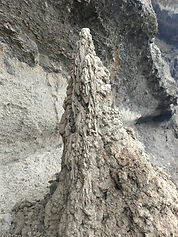
In winter, water comes out of the borehole, and the surrounding air temperature is below zero; the water freezes almost instantly. This is why such very interesting ice objects form. I dream of seeing it in person—it is incredibly beautiful.
Hanna Zubkova
So, if the previous ones were your photographs, here you are in contact with someone who is already there, on site? I’m clarifying, because I may not have caught it: does this person actually collect samples for you as well?
And this shows that a scientist cannot operate entirely alone, that they are constantly interacting with others. It’s not a “lone warrior in the field.” And, strangely enough, despite the narrow specialization and the specificity of knowledge, this way of working still has a potential to involve other people in the process.
Valentina Palamarchuk
Yes, of course. We almost always interact with people on site, and help is very important.
If we speak about ices that form without a person’s direct participation (although, of course, everything today is in one way or another indirectly connected to human influence), then I encounter them very often in the field.
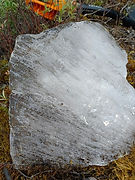
Ice can exist simply within the rock—in pores, in cracks. Sometimes it forms beautiful inclusions. For example, in the far-right photograph you can see how light passes through the core—literally as rays.
Sometimes ice forms the structures of frost heave mounds. And this kind of ice… when I first saw it, I had the feeling that I wanted to touch everything.
This is needle ice. It forms under specific conditions: when there is water on the surface with a temperature above zero, while the surrounding environment is below zero. Due to capillary action, water is drawn upward and forms these needle-like structures.
Hanna Zubkova
What does it mean that water can be warmer than the surrounding environment? Is that possible?
Valentina Palamarchuk
Yes. Springs can be warmer as well. This often occurs during the melting of an icing in spring: there can be sharp temperature fluctuations—from below zero to above zero and back.
So the melting process has already begun: water is flowing over the icing, and then suddenly it drops below zero again—minus five, minus ten. And due to the capillary effect, water is pulled toward the freezing front and forms these “stems.”
Hanna Zubkova
So nothing exists in a frozen, static form: something is always moving, processes of transformation are always happening. But at the same time there are ices that stand for centuries—and it seems as if nothing changes?
Valentina Palamarchuk
Yes, this continues the theme of ice. This is polygonal wedge ice. It exists on Yamal as well.
I don’t study it directly, but we research it together with colleagues—for a professor in Moscow. He works in paleogeography, and it is important for him to study polygonal wedge ice because it reflects the conditions under which it formed.
This ice forms like this: in winter, under severe conditions, a crack appears at the surface. In spring or summer, water flows into the crack—meltwater from snow. Then, in the next winter period, it freezes. This process can repeat again and again. As a result, wedge-shaped structures form; they expand and can reach gigantic sizes.
The ice in this photograph is about three meters high.
Hanna Zubkova
Am I right in understanding that such ices can be very ancient?
Valentina Palamarchuk
Yes, they can be ancient. To be honest, I don’t remember the exact age of these specific ones—there are different articles on this topic.
My colleague said that this ice is not older than eight thousand years. In principle, such structures can be much older—up to several hundred thousand years—but that depends on the site.
Hanna Zubkova
And there are freezing processes—and there are thawing processes. In the far-right photograph you can see how these structures thaw in summer, and all this “dirt” remains. So it is not pure ice: it contains inclusions of soil. It melts and forms these shapes. And if we speak about the periphery of the desert, water flows into them, but around these objects the life of water is everywhere: springs actively gushing from underground.
Valentina Palamarchuk
Yes. In the Chara Basin nature is very dynamic. This white spring has a different origin than the springs in the Sands tract. This spring circulates year-round; the water temperature is about four degrees. It emerges from a tectonic fracture—waters are constantly flowing through it. That is why this spring is unique, and even in its chemical composition it differs from the springs I observe on the sands.
Hanna Zubkova
And you can see from the appearance that they are different as well. There everything is bubbling, and here the funnels discharge more calmly.
Valentina Palamarchuk
Yes, it is a different type of discharge. At the bottom of this spring-lake, “gryphons” boil—an interesting term. And every year the number of these small “fountains” rising through the water changes—this reflects the dynamics of the place. It’s not that it always comes out of one “hole”: each time they find different outlets.
And here are the icings we were talking about: in spring they begin to melt and form grottoes with water flowing underneath, or beautiful patterns appear on the surface.
This year the ice was especially beautiful—bluish in tone.
Hanna Zubkova
What causes this tone? And where, for instance, does the red color and these streaks come from?
Valentina Palamarchuk
When an icing forms, it “captures” part of the material: inclusions of plants, sand, and so on. Then it all melts and, naturally, gives color. Sometimes, by the way, I was told that even cobblestones are found in icings—that is, an icing can “drag” a rather large stone.
Hanna Zubkova
So from these patterns one can предполагать what is more present there—for example, plant inclusions or something else. And it turns out that the crusts you mentioned are precisely what remains from icings, and they too can be used to study the composition of the water that was here.
So there are many forms: ice, water, crusts—and this is all one process that manifests differently, sometimes seasonally. And you collect not only water but also different material forms?


32


Valentina Palamarchuk
Yes, we try to collect everything we can. But there are constraints: how many kilograms we can carry ourselves, and laboratory limitations—not all samples can be analyzed. So we have to choose: we take this now, this next time. And here is another interesting point about forms of matter. We were walking back to camp, decided to rest under a tree, lay down—and didn’t understand what we had lain on. It was not a sandy surface but some kind of crust. For a long time we couldn’t understand why it had formed there. It turned out we had lain down under a larch: resin drips from it, and the resin together with sand cemented it into a crust. It was unexpected: we thought we would lie down on soft sand, but ended up on a hard crust.
Hanna Zubkova
It’s striking that this spreads in that way as well. It seems that processes are constantly happening there, and they are not always obvious. And from all your stories I had the sense that a “still image” of a landscape is never what it seems in a captured moment. There is constant transformation; every second something changes.
And nature seems to leave traces on its own—without intending to impress anyone. These are simply interconnected processes. Each trace means that something happened, and this trace leads to the next event.
So a scientist observes not so much an object as a fixed thing defined by a frame, but rather change—transformation.
Valentina Palamarchuk
Yes. It is always interesting to observe a process dynamically—in order to describe it more precisely. In the moment it is very hard to understand everything.
We arrive in the field, see it in one state, collect material. And that is why we return many times—to see how everything lives and changes.
Hanna Zubkova
It even resembles performative practices in contemporary art: the viewer always sees only a fragment, in the moment. Experience has no strict beginning or end—you assign your own beginning and end to your encounter with that fragment.
And here it is the same: the processes are cyclical, but they constantly develop—as if along a spiral.
Valentina Palamarchuk
I remember these two photographs—they were very indicative. I took them with less than a day between them.
On the first day we came to measure discharge, but my rotor broke, and I only got this photo on the left. The next day we came again: at night it rained, and we saw a completely different picture—everything in water, it’s unclear where to establish the cross-section. And it happened very quickly, before our eyes.
Then I thought: nature in Chara is truly very dynamic. People live their own more “slow” life, but the nature of Chara can be compared to a мегаполис: everything is constantly happening there, nobody is waiting for you.


33
Hanna Zubkova
And I was struck by the photograph where someone from your team is standing on a surface that looks as if it might collapse at any moment. If everything changes so quickly there, aren’t you afraid? Can you understand: here it is safe, here nothing will fall in? Does knowledge help you avoid danger?
Valentina Palamarchuk
Yes, the first impression can be frightening. I also worried at first. But if you come closer, you can see that the cracks are shallow. This is the effect of frost heave: because of water and freezing, the surface heaved a little, then cracked—and such fissures appeared. If you look carefully, it is usually safe. But it’s not like that with all cracks: sometimes you really do need to walk very carefully.
Hanna Zubkova
So the surface can also “tell” what is happening inside. That is also a trace of an event that is invisible to our gaze.
Valentina Palamarchuk
Here you have many processes in one photo—this is Yamal, my first expedition. We were flying by helicopter, and from above I saw how diverse the relief of Western Siberia is. People sometimes say there is “no relief” there, but relief exists everywhere—and from a helicopter you can see it.
The Yamal tundra is very beautiful. Here we see blowouts—on the far-right photograph: one can assume that there the seasonally thawed layer, which thaws in summer, will be deeper.
We see small streams—this is thermo-erosion: there is a strong incision around them, the territory is wet. There are also such “oases.” There are processes of landslides—in the permafrost zone they are called cryogenic landslides.
And one of the most beautiful photographs is polygons: on the surface they look like this, but internally it is connected to polygonal wedge ice, wedge-shaped veins. On the surface it manifests as a polygonal pattern. When permafrost thaws, lake basins form. If you fly over Yamal, you see many lakes—this is precisely the result of thermokarst.
Hanna Zubkova
So one can also formulate hypotheses from the surface—if you have certain knowledge. But you would probably like to reach the Yamal desert as well—I understand it also exists?
Valentina Palamarchuk
Yes. It is “so close, yet so far.” I travel farther to Chara than to the Nadym sands, but logistics to Nadym are very difficult, and I have still never been there. I really hope I will go. Even from satellite imagery you can see that they differ from other deserts: around them there is a huge number of bogs. I think the conditions and the behavior of water and permafrost there will definitely be different from the massifs where I have already been.
Hanna Zubkova
And as I understand it, as in art, science also has situations where research is free—not tied to pragmatic tasks. It does not necessarily solve a problem of infrastructure or applied need. And then it is truly “lonely” in its path—and you need passion to carry it through. I very much hope that this passion will take you there as well.
And I will probably conclude our conversation by returning to our field—to the experimental field, but also an archival one. Perhaps it will become history: they may build some residential or commercial complex there, and it will become yet another page.
And perhaps, in the sculpture Solid Amid which is on view for the last day today in the neighboring hall, I wanted to fix one moment—something impossible to hold in its entirety—and imprint it in the form of a sculpture. It partly resembles a drilling rig. I was inspired by its stability on that very “solid ground” which is, in fact, not so solid: it is variable, dynamic.
May I ask you a small follow-up question about one photograph? I remember you once told me about it. In it you look as if you are hanging on in an abysse, holding onto a stick.
Valentina Palamarchuk
Yes, we walk from spring to spring, record them using GPS, write the data in a notebook. And at that moment I was not very careful when approaching the edge and fell.
But I thought it was nothing serious and kept working. I have the GPS in my hand, I continue to enter the data, literally hanging in that position. I like that the person who took the photo thought, off-camera: “Something is happening to Valentina, I should take a picture.”
Hanna Zubkova
For me it was a very precise image of a researcher—a person in a vulnerable, unstable position, but continuing to register, measure, work. I think this is also an important part of our conversation about permafrost: about how both the human being and the environment exist in a state of instability.
It seems to me that at some point it became clear that what unites us is not only a specific object—a borehole or permafrost—but also a mode of thinking itself. The way we look at processes that for the most part remain invisible.
For me it was important to see that scientific methods—whether tomography, acoustic measurements, or video recording inside a borehole—are not merely instruments of documentation, but ways of entering into contact with what is hidden from direct sight.
And in this sense scientific work turned out to be very close to artistic work. Because in both cases there is an attempt to make visible what cannot be seen directly.
When I started working on the installation, I wanted not so much to reproduce the scientific process as to preserve this sensation of penetration—of approaching something that keeps slipping away. That is why the work includes the borehole video, the visualizations, and fragments of material that refer back to those investigations.
Valentina Palamarchuk
For me this encounter was important as well, because it allowed me to look at my own work from the outside. In everyday scientific practice we rarely think about how our actions, our instruments, our data look.
When Hanna started asking questions—sometimes very simple, sometimes, on the contrary, unexpected—I caught myself having to reformulate anew what had seemed obvious to me.
It was a useful experience, because science is also constantly engaged in translation: we translate natural processes into graphs, numbers, models. And in this translation something is always lost, while something else, on the contrary, becomes visible.
Hanna Zubkova
In the end, for me the question of language was also important. How language—including scientific language—tries to describe the world, and where it stops being adequate.
We say “permafrost,” but it is not permanent. We say “solid ground,” but inside it there is movement, water, instability. And at a certain point language begins to contradict reality.
In such moments, as I see it, a space for art emerges—not as an illustration of science, but as a way to hold complexity without reducing it to a single model or a single explanation.
Valentina Palamarchuk
I agree. In science we also constantly encounter the fact that words and models are conditional. We use them because without them it is impossible to work, but we understand that they do not exhaust reality.
Permafrost is a very complex system, and the more we study it, the more we understand that it changes, reacts, and is in constant process.
Hanna Zubkova
I think it is precisely at this point—between knowledge and not-knowing, between documentation and experience—that a dialogue between art and science emerges.
And for me this dialogue is important not as an attempt to find a common language once and for all, but as a process that remains open.
Efim Khorolya (moderator)
Thank you very much to Hanna and Valentina for this conversation. We now have time for questions from the audience.
Audience question
Valentina, I would like to ask about the future of these sands. What will happen to them in the future? Will they expand or, on the contrary, become overgrown with vegetation due to global warming? What awaits us?
Valentina Palamarchuk
So far the trend is that the sands are becoming overgrown. There are quite a lot of studies—also on the Nadym sands—cartographic studies showing that over the last 50 years they have become significantly overgrown.
For Makhatta and for Chara we also conducted such studies: we analyzed changes in area and found that the area covered by vegetation is increasing. So at the moment the trend is precisely overgrowth.
Of course, if the climate shifts in a different direction, the scenario could be different. Some scientists believe that the sands, on the contrary, are expanding due to wind processes. There is also the view that these are already fairly stable formations.
But personally I lean toward the second position: most likely, in the long run, the sands will become overgrown.
Audience comment
When you look at maps and satellite images, the work of wind becomes especially visible—these waves, these reliefs. You really feel it visually.
And how quickly can houses in Salekhard begin to deteriorate? How serious is it?
Valentina Palamarchuk
If we speak specifically about Salekhard, houses built on piles will certainly last much longer. Unfortunately, there are still many old wooden houses here, and they are indeed less stable: permafrost degradation has already affected them—they “move,” deform.
How long a particular house will stand depends on the situation: on the state of the ground, on the construction, on whether there is permafrost beneath the building or whether it has already degraded. In some places there was never permafrost; in others it lies close to the surface.
Audience comment
There is a local meme that the Romantikov Glacier will melt exactly by the moment I finally decide to go there. Is that true?
Valentina Palamarchuk
In fact, in our department we have Alexander Shein. Every year he studies the dynamics of these glaciers. So far the trend is that they really are melting. How fast depends on the specific site. So if you want to see it, it’s better not to postpone.
Hanna Zubkova
I think this is the key theme of time that we have been speaking about a lot today. We see how quickly conditions change: you come into the field—and the very next day everything looks different.
And this is directly connected to what we call “permafrost.” In fact it is not permanent, but multi-year. It degrades, transforms, and it affects literally everything—from landscapes to infrastructure.
Vernadsky spoke about this in a philosophical dimension. Vernadsky did not think of permafrost as a time capsule, but his understanding of the Earth as a system of material memory makes it possible to reinterpret permafrost today as an uncontrolled archive that suddenly becomes oriented toward the future.
Thank you very much for being here, for your questions, for your attention.
Valya, thank you so much for the worlds you opened for me—and for all of us today.

34


35

36
-
Ice glaze / from field materials by Valentina Palamarchuk
-
Hanna Zubkova and Valentina Palamarchuk, conversation in Salekhard
-
Videos from Axe de Révolution / Hanna Zubkova and Katya Ev
-
Performance diagram
-
Performance map, from the northernmost point of Moscow to the southernmost, passing through the geographical center of the city, Revolution Square
-
Page from Copernicus’s book On the Revolutions of the Celestial Spheres
-
Diagrams of Moscow, the solar system, and the atom
-
From Hanna Zubkova’s field materials for the project False Sun
-
Photographs from the project False Sun, Hanna Zubkova
-
Video fragment False Sun. The Catcher, Hanna Zubkova, 2022
-
Photograph from a kindergarten building, Rudnik, Vorkuta
-
Diagrams of parhelion, online source
-
Photograph of a parhelion, online source
-
Documentation of the installation False Sun. Fragment, Ethnographic Museum of Saint Petersburg
-
View of the field of the former agricultural experimental station, Salekhard
-
Fieldwork from Hanna Zubkova’s materials for the project Solid Amid
-
From the fieldwork materials of Valentina Palamarchuk
-
Tukulans, from the fieldwork materials of Valentina Palamarchuk
-
Electrical tomography documentation, from Hanna Zubkova’s fieldwork materials for the project Solid Amid
-
Electrical tomography documentation, from Hanna Zubkova’s fieldwork materials for the project Solid Amid
-
Fragment of the sculpture Solid Amid, Hanna Zubkova
-
From the fieldwork materials of Valentina Palamarchuk
-
Tukulans, from the fieldwork materials of Valentina Palamarchuk
-
Sample collection, from the fieldwork materials of Valentina Palamarchuk
-
Photographs of sand types in tukulans, from the fieldwork materials of Valentina Palamarchuk
-
From the fieldwork materials of Valentina Palamarchuk
-
From the fieldwork materials of Valentina Palamarchuk
-
From the fieldwork materials of Valentina Palamarchuk
-
Ice varieties, from the fieldwork materials of Valentina Palamarchuk
-
From the fieldwork materials of Valentina Palamarchuk
-
From the fieldwork materials of Valentina Palamarchuk
-
From the fieldwork materials of Valentina Palamarchuk
-
Difference in water body levels over 24 hours, from the fieldwork materials of Valentina Palamarchuk
-
From the fieldwork materials of Valentina Palamarchuk
-
View of the field of the former agricultural experimental station, Salekhard, Google View 2022
-
View of the field of the former agricultural experimental station, Salekhard, from archival sources, 1929